Reviewed by The Quidnunc
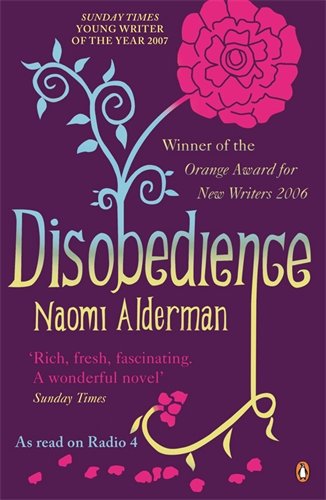
"Disobedience" as a Jewish-world-revealed type of novel. Firstly, I should probably mention that I am not a particular fan of books that tell the stories of religious struggling and religious communities. You see, religion and I, we don't get along very well. However, I will attempt to be as objective as possible when judging Disobedience.
The story alternates the perspective of Esti, a
not-altogether-happily-married observant Jewish woman, with that of
Ronit her childhood friend. The women are reunited when Ronit returns to
Hendon after the death of her father, a much esteemed Rabbi. The two
viewpoints shed light on what is good - and what is a little less good -
about life in a tightly-knit Orthodox community.
Each chapter begins with a discourse on aspects of Jewish beliefs and practices. These passages serve to lift the book beyond being just one more 'feel-good' story about women re-evaluating their lives. Although, I admit they were very educational for someone who is not familiar with the Jewish tradion, I found them annoying and boring. It seems they stole the colour of the pages of this otherwise decent novel.
Each chapter begins with a discourse on aspects of Jewish beliefs and practices. These passages serve to lift the book beyond being just one more 'feel-good' story about women re-evaluating their lives. Although, I admit they were very educational for someone who is not familiar with the Jewish tradion, I found them annoying and boring. It seems they stole the colour of the pages of this otherwise decent novel.
Most of the time I was haunted by the feeling that Alderman followed a recipe for writing rather than her own voice. And this is what lead to the very Lenten sense of humour. It was funny at times, but mostly it was just a sad attempt of sense of humour.
One of the obvious disadvantages of the novel is that the principals, and the world of the Orthodox (Jewish) British community is presented in such a compelling detail that it becomes almost claustrophobic for someone as free minded as me.
 But I guess a novel like this takes a bit of warming up time to take in. It's
incredible to think that this book was written by such a young woman.
It is wise beyond her years. Much of it has an omniscient narrator whose
range extends from ironic commentary on the quirks of the Orthodox
Jewish community to Torah lessons that I was still pondering days later.
The contrast between that all-inclusive narration and Ronit's brash,
self-absorbed first-person voice helps set up the problems of the novel.
But I guess a novel like this takes a bit of warming up time to take in. It's
incredible to think that this book was written by such a young woman.
It is wise beyond her years. Much of it has an omniscient narrator whose
range extends from ironic commentary on the quirks of the Orthodox
Jewish community to Torah lessons that I was still pondering days later.
The contrast between that all-inclusive narration and Ronit's brash,
self-absorbed first-person voice helps set up the problems of the novel.
With this said I am not surprised it won the Orange Award for New Writers, BUT I will not dare recommend it to any of the readers I know, for it just lack severely in character.